

Your fortnightly SEO, GEO and AEO round-up, starting with AI cold calling business to seek quotes.
Back for round two, and search and AI Visibility news has not sat still for a second. In one short fortnight we have a fresh AI calling for quotes, Reddit wobbles, Google update, and AI answers becoming your textbook, plus more... Welcome back to Wired For Visibility, your fortnightly sweep of everything shifting in AI visibility, SEO, GEO and AEO. Five minutes, and you are up to speed.
Google’s AI is cold-calling businesses for prices. Do we get to pick tb Should we be happy or concerned?
Local and AI. Reported, August 2026.
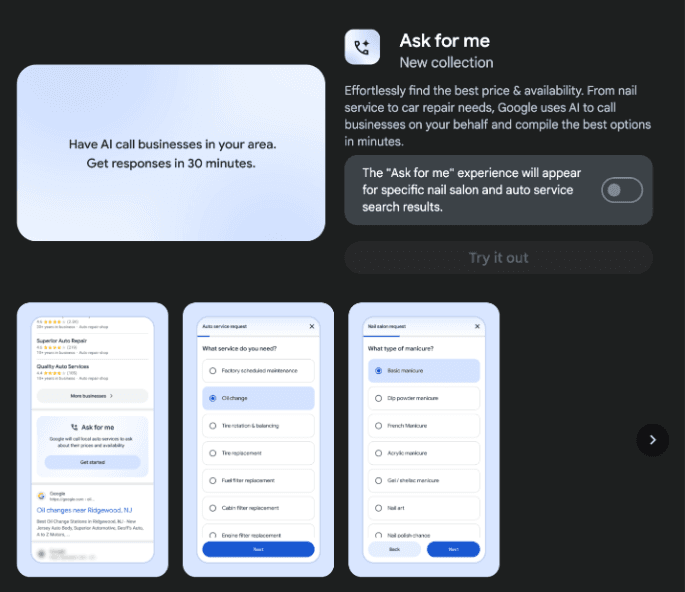
Google has a new AI party trick called “Ask for Me”. In the US, someone hunting for a local service, can now simply tap “have AI check pricing”, and Google’s AI literally rings around on their behalf, collects quotes and availability, and emails them a tidy little shortlist. Wild!
So, the first a business hears of a customer is a robot asking its rates, and by the time a real human shows up, the business is already lined up against every competitor. This new feature could be landing on our doorstep any day now, and with zero notice. Keep a look out!
Sources: Search Engine Journal.
Our take: This is giving us the ick, but at the same time, we're kind of intrigued to see how this plays out. For consumers, this will save a truck load of time by not having to contact businesses who don’t publish their prices. For businesses, it could be a bit fiddly, because a bot ringing for a price is not a customer with their wallet out ready to make the purchase.
So, teach the team to sniff out the AI caller, pop those calls in their own assigned column, and keep a consistent price narrative for when the “customer” is a robot on a fact-finding mission. Bottom line, the businesses that answer fast, quote clearly and look like the safe pick are the ones that will win the business.
Australia just told big tech to pay for news, whether they show it or not
Policy. Confirmed, Australia, August 2026.
A happy and BIG news piece for Aussie news rooms! Platforms like Google and Meta make a fortune from Australian ad revenue, and part of what keeps us scrolling and searching is news that Australian newsrooms pay good money to produce. Very little of that money finds its way back to the reporters. Last week Parliament passed the News Bargaining Incentive to fix that, but it’s more of a nudge than a bill: Google, Meta, TikTok and LinkedIn now face a 2.75 per cent charge on their Australian ad revenue, but they can wipe most of it out by signing deals to pay Australian news publishers directly. Pay the newsrooms, or pay the government . Either way the money moves toward journalism.
An earlier 2021 law only applied if a platform carried news, so Meta simply dropped news in 2024 and strolled out the back door without paying a cent. This time the charge is tied to ad revenue, not to whether news is on show, so there is no door left to stroll through. It is a company-wide levy with a discount for doing right by journalism, nothing more.
Why it lands in a visibility round-up, even though it is not an SEO tactic: it is really about the value exchange search has always run on. Publishers make the content, search surfaces it, the traffic comes back as revenue. That deal was already fraying, and AI answers stretch it further, more answers, fewer clicks, and less traffic flowing back to the people who did the reporting. Right now, three fixes are being tried at once: regulation like this, direct licensing (think OpenAI and News Corp), and publishers finding ways to control how AI reaches their content. No one has cracked it yet.
Our take: We LOVE this. Anything that supports Australian journalism, we are all for. This situation does spark a big question in our mind when it comes to AI though - if AI answers the query with news content, but the click never happens, who funds the content the answer was built on?
Remember the handshake between Reddit and AI? It just took a wobbly turn
GEO. Study, August 2026.
Last edition we flagged how heavily AI leans on Reddit (because Google and AI pay for the content). Two weeks on, the opposite: Reddit’s citations in ChatGPT prompts fell around 86 per cent in a matter of days, from 3.83 per cent of citations (18 July to 7 August) down to 0.52 per cent (14 to 17 August). And, no one has fully explained why.
Sources: Search Engine Journal.
Our take: this is the whole lesson about AI visibility: it moves fast, often, and without notice. We see the same swings in the prompts we track for our clients. So let’s not rest on our laurels and rely on any single platform being the source AI loves this month. Spread your presence across the places that matter (we call this the One Visibility approach), keep measuring, and treat a sudden surge or drop as a weather shift, not climate change.
Google dropped a spam update. Did your traffic feel it?
SEO. Confirmed, Google, August 2026.
Google started rolling out its August 2026 spam update on 18 August, its third of the year. In plain English, a spam update is Google giving its junk filter a tune-up, so it gets sharper at catching content that breaks the rules, think mass-churned pages, sneaky redirects, and sites built for robots (for short cut ranking purposes) rather than humans. It is global, covers every language, and Google says it may take a few days to fully land. The spam policies page has not changed since December, so this is Google enforcing the rules it already has, not a new rulebook.
Sources: Google Search Status Dashboard, Search Engine Land.
Our take: if you write for people and keep things clean, this is a no brainer, and your brand should not be impacted. If you saw a step-change in traffic around 18 August, do not guess, line it up against the rollout dates first. Spam updates go after thin, mass-produced content, so the fix is quality and originality, not sneaky workarounds. Anything important, such as original and fresh content, we will not stop repeating, especially after last edition’s update on Claude’s watermark for detecting AI generated content. Do not take this lightly.
The AI answer is turning into an interactive textbook
GEO. Reported, Google, August 2026.
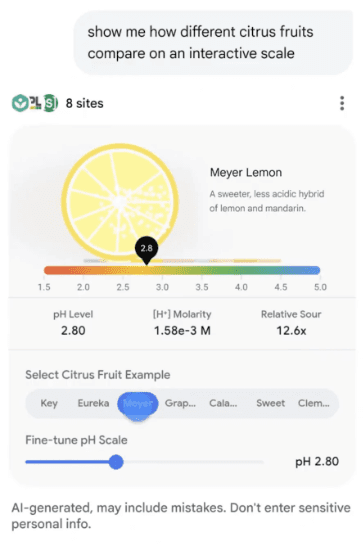
Google is rolling generative UI into AI Overviews (AIO), after testing it in AI Mode. Instead of just text, the answer in AIO can now build little interactive tools such as a calculator for your mortgage. Think of an interactive textbook, where the explanation comes in text with supporting diagrams and tables to help group the theories. It is going out globally in English, with no finish date given.
Sources: Search Engine Journal.
Our take: This is cool! Since it’s still rolling out, there’s not yet any test to see how we can optimise for it. But looking at why and how Google can build the calculator or the comparison table, Google wanted to make the complex answers more visual and digestible. Therefore, winners will be brands offering something the answer cannot easily rebuild: real expertise, real data, a rich database, a genuine reason to click through. On the other hand, pages with built-in tools or calculators are not the right fit for this. Or we could be wrong, and Google takes the tools directly from those sites to show in the answers without regenerating them.
Advertisers: Google switches you to AI Max on 1 September, automatically
Ads. Reported, Google, August 2026.
From 1 September, Google will automatically upgrade eligible Search campaigns to AI Max. If you use automatically created assets or campaign-level broad match, you will get AI Max features like search-term matching and text customisation switched on by default. It is not opt-in, it just happens, though Google says it will mirror your current settings as closely as it can.
Sources: Search Engine Land.
Our take: take a good look, because SEM is SEO’s close relative and will likely impact your organic performance. Check which campaigns are in scope and whether the wider matching could push your ads into places you did not intend. Our paid team is across it, and because AI Max leans harder on Google’s automation, the brands watching their search terms and creative will get more out of it than the set-and-forget crowd. To sum up, your search campaigns will need more love and attention this September to figure out what AI Max does to your campaigns.
_______________________________
And that is a wrap for this fortnight. The engine changed, the spam net tightened, Reddit learned that AI fame is fickle, and Australia had a crack at the question no one has answered yet: who pays for the news when the click disappears. Ranking still matters, being the name the AI recommends matters more, and the market is still only just catching on. See you in two.
